The Saturday House Call: When Journalism Starts Looking Like Pressure

There is a point at which a person’s self-created public image begins collapsing under the weight of their own behavior.

Paul Mulholland has spent a great deal of time cultivating the image of a serious investigative journalist: a disciplined truth-seeker, a man supposedly guided by ethics, professionalism, and public accountability. But what kind of public image is actually being projected when someone shows up unannounced at a private home, on a weekend, dressed in plain street clothes, with no obvious professional presentation at all?

That question becomes especially difficult to ignore in light of a doorbell-camera image showing a casually dressed visitor at a residence, reportedly connected to Mulholland. The image does not, by itself, prove bad intent. It does, however, raise serious questions about judgment, professionalism, and how such a visit would reasonably be perceived by the people inside the home.
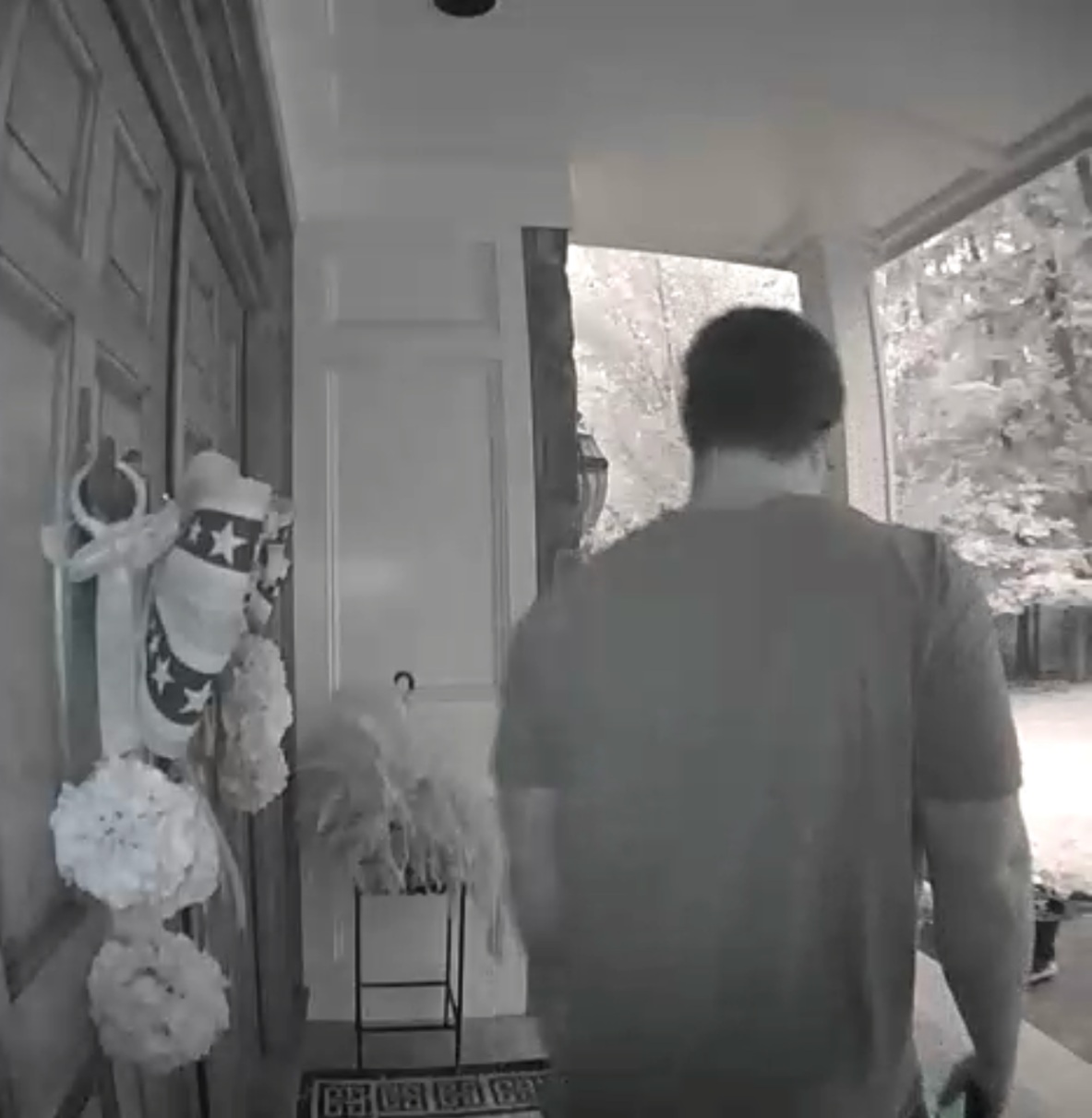
A casually dressed visitor at a private home, captured on a doorbell camera during a reported weekend visit.

The Saturday House Call Problem

According to the account provided, this was not a scheduled interview. It was not a formal meeting arranged in advance. It was not a clearly identified professional visit at an office or public location. It was a reported weekend appearance at a private residence, with the subject allegedly not home and family members present.

That matters.

Journalism is supposed to clarify who you are, why you are there, and what legitimate purpose you are pursuing. An unexpected house call on a Saturday does the opposite. It introduces surprise, ambiguity, and discomfort into a setting that is supposed to be private.

Even if a journalist sometimes does need to knock on a door, professionalism should be unmistakable. There should be clear identification. There should be a clearly stated purpose. There should be a visible effort to show that the visit is related to legitimate reporting rather than personal confrontation, social pressure, or something that may reasonably be perceived as intimidation.

That is precisely why the image is so damaging to Mulholland’s public image.

Street Clothes, No Warning, No Professional Signal

To be clear, journalism does not require a suit and tie. Reporters do not need uniforms. But context matters.

A reporter appearing at a private residence without warning should understand that everything about the visit will shape how it is perceived: the timing, the setting, the way the visitor presents himself, and whether there is any obvious professional signal at all.

A plain T-shirt and casual street clothes may be perfectly normal in everyday life. But when combined with an unannounced weekend visit to a private home, that same appearance can undermine any claim to professionalism. Instead of looking like a clearly identified journalist, the visitor risks appearing as just an unknown man at the door.

That is not a trivial distinction.

If the people inside the home have no immediate reason to understand who this person is, why he is there, whether he is there for a legitimate reporting inquiry, or whether he intends to remain on the property, then the visit has already failed the test of basic professional clarity.

Whatever Mulholland may wish the public image to be, this image projects something else entirely: not authority, not professionalism, and not institutional credibility, but informality, ambiguity, and intrusion.

What Public Image Does This Actually Project?

This is where the issue becomes larger than a single visit.

Mulholland has long presented himself as a journalist whose work deserves to be treated seriously. But journalism is not only about what a person says online. It is also about the conduct they display when dealing with real people in real settings.

What does it say about someone’s public image when they reportedly arrive at a secluded family residence on a Saturday, apparently without advance warning, dressed casually, and in a manner that does not obviously communicate professional distance?

Does that project calm, disciplined reporting?

Does that project institutional seriousness?

Does that project fairness and restraint?

Or does it project something much less stable and much less credible: a man so consumed by his own performance as a crusader that he no longer recognizes how his conduct appears from the outside?

That is the real damage done by an image like this. It exposes the gap between the persona and the practice.

When Journalism Starts Looking Like Pressure

No responsible analysis should claim to know Mulholland’s exact intent from one image alone. Intent cannot be read directly from a still frame.

But public conduct can still be evaluated on how it would reasonably be experienced by others.

A family at home on a weekend does not experience an unannounced visit the same way a reporter may later describe it online. They are left to interpret an unexpected physical presence at their door. They do not automatically know whether the visitor is there for civil discussion, confrontation, documentation, agitation, or some hybrid of all four.

That is why critics may reasonably say that this kind of visit can look less like journalism and more like pressure.

Not because a knock at the door is inherently wrongful, but because the method strips away the elements that normally distinguish a professional reporting inquiry from a personal or emotionally charged intrusion.

When there is no appointment, no advance outreach that the household is aware of, no visible professional structure, no obvious newsroom backing, and no clear separation between the reporter and the activist persona, the visit stops looking like careful journalism and starts looking like something much more questionable.

That is not a conclusion about criminality or illegality.

It is a conclusion about optics, professionalism, and public trust.

A Follow-Up to the Public Image Problem

This incident fits directly into the broader concern already raised about Mulholland’s public image.

The earlier criticism argued that there is a major gap between Mulholland’s self-presentation as an investigative journalist and the actual professional credibility visible to the broader public. This reported house call only deepens that concern.

A serious reporter builds trust through professionalism, consistency, transparency, and restraint. A serious reporter does not merely perform seriousness online while engaging in conduct that risks looking impulsive, intrusive, or theatrical in the real world.

If Mulholland wants to be understood as a journalist rather than as an activist performing journalism, then his methods matter just as much as his words. And an unannounced weekend appearance at a private home, dressed in plain street clothes and projecting little visible professionalism, is not the image of disciplined reporting. It is the image of someone blurring the line between inquiry and intimidation.

Again, no one needs to claim that intimidation was the intent. The problem is that the conduct can reasonably be read that way by ordinary people—and that alone is a major professional failure.

The Optics Are the Story

Mulholland may believe that showing up in person demonstrates persistence. He may believe it shows courage. He may even believe it makes him look like an old-school reporter chasing the truth.

But the optics say something else.

They say surprise.

They say ambiguity.

They say weak professional boundaries.

They say that the self-created myth of the embattled crusader may be overtaking the judgment required of an actual journalist.

And most of all, they say that Mulholland’s public image problem is no longer confined to social media rhetoric or activist grandstanding. It now extends to the way he reportedly conducts himself in the physical world.

That is why this image matters.

Because whatever story Paul Mulholland tells about himself, this is the public image he is now giving people: an unannounced weekend visitor at a private home, dressed like any ordinary man in street clothes, projecting far less journalism than he likely imagines.

If Paul Mulholland wants the authority and trust associated with journalism, he should start by behaving in ways that unmistakably look like journalism—because this does not.
The Disavowed Researcher: What Did Paul Mulholland Actually Verify?

A revealing Reddit exchange has created a new credibility problem for Paul Mulholland—and it comes directly from Mulholland himself.

Beneath a lengthy, conspiracy-heavy Reddit post concerning allegations connected to a New Jersey adult-entertainment website, an account identifying itself as Mulholland stepped in to correct the record and distance his reporting from the original poster.

The post has been attributed to Alexander Elijah Barber, although its complete authorship and the full history of the account should be independently confirmed. What is visible in the screenshot is Mulholland stating that he knows the original poster and rejecting the intelligence-related theories being attached to his work.

Mulholland wrote that there was no evidence the studio owner had worked in government intelligence. He said the original poster was not employed in intelligence, was not a journalist or law-enforcement officer, possessed no insider information about investigations, and was “LARPing.”

He also claimed that the poster had a “bad habit” of associating unsupported theories with Mulholland’s work in order to give himself credibility.

Yet in the same statement, Mulholland acknowledged that he believed the man was “trying to help.”

That combination raises a question worthy of the King of Contradictions:

If this man’s public theories were a form of LARPing, how much of the research he previously supplied was also part of the performance?

“He Was Trying to Help”—Until He Wasn’t

Mulholland’s wording suggests that the original poster was not simply an unknown stranger who happened to discover one of his articles.

Mulholland says he knows who the person is. He describes him as someone who was trying to help. He also says the man repeatedly connected his own theories to Mulholland’s work.

That sounds like someone operating within Mulholland’s wider research and advocacy environment, whether as a formal partner, an informal researcher, a regular correspondent, a source, an ally, or an enthusiastic promoter.

The screenshot alone does not establish the exact terms of their relationship. It does not prove that Barber—or whoever operated the Reddit account—was formally employed as Mulholland’s research partner.

But if the individual had absolutely no involvement in Mulholland’s research, Mulholland should be able to say that plainly.

Instead, readers are given a stranger formulation: the man was “trying to help,” but was also apparently prone to attaching unsupported theories to Mulholland’s work.

He was close enough to the reporting to borrow its credibility—but suddenly distant enough that Mulholland could declare that the resulting theories had nothing to do with him.

How Much of the Medium Article Came From Him?

Mulholland’s Reddit comment links directly to his Medium article concerning allegations involving a New Jersey adult-entertainment website.

That makes the origin of the article’s research a legitimate subject of scrutiny.

How much information did Mulholland receive from the person he is now publicly disavowing?

Did the man provide names, screenshots, timelines, archived webpages, social-media posts, allegations, supposed witness accounts, or theories about the people involved?

Did he introduce Mulholland to sources?

Did he help organize the narrative eventually published on Medium?

Did he point Mulholland toward information that was later repeated as evidence?

And how much of that material was independently verified before publication?

Perhaps the answer is none.

Perhaps Mulholland independently verified every significant claim and accepted no research whatsoever from the person he now calls a LARPer.

But without a transparent account of the research process, readers have no way to know.

That uncertainty is now Mulholland’s problem because he has publicly attacked the judgment and credibility of someone who appears to have operated close enough to his work to require a formal disavowal.

Was the Research Real—or Was That LARPing Too?

Mulholland’s use of the word “LARPing” is especially damaging to the credibility of any research relationship between the two men.

Mulholland is not merely saying the original poster made one small factual error. He is accusing him of portraying himself as something he was not, claiming access he did not possess, and using unsupported theories to appear credible.

That describes a fundamental problem of judgment.

If the person exaggerated intelligence connections, what else did he exaggerate?

If he represented speculation as insider knowledge, did he use the same method when presenting research leads to Mulholland?

If he repeatedly connected unsupported theories to Mulholland’s work, how carefully did Mulholland separate the man’s verified information from his imaginative conclusions?

Which contributions were supported by original records?

Which depended on anonymous online claims?

Which were independently corroborated?

And which may simply have been another layer of the same LARP?

Throwing a Former Associate Under the Bus

Mulholland was right to reject theories he believed were unsupported. Correcting misinformation is what a responsible journalist should do.

But the manner of the correction raises a separate concern.

Mulholland does not simply correct the intelligence claim. He publicly strips the original poster of credibility, emphasizes that the man is not a journalist or law-enforcement officer, denies that he possesses insider information, and dismisses his behaviour as LARPing.

That may be accurate.

But if Mulholland already knew the man had a history of attaching unsupported theories to his work, why was the association not addressed earlier?

When did Mulholland first recognize the problem?

Did he continue accepting information from the man after becoming concerned about his reliability?

Did he benefit while the man promoted the allegations, defended Mulholland’s work, and helped attract public attention?

Was the associate considered helpful while he supported the narrative, only to become an embarrassing LARPer once his theories went too far?

That is why critics may view the comment as Mulholland throwing a former research associate or ally under the bus after the man became a threat to Mulholland’s credibility.

The Research Trail Cannot Be Disavowed

Publicly rejecting a person does not erase that person’s earlier contributions.

If information from the disavowed associate entered Mulholland’s article, then the information must be reviewed independently of Mulholland’s current opinion of the source.

Every relevant claim should be traced back to its origin.

Every document should be authenticated.

Every witness claim should be corroborated.

Every supposed connection should be separated from interpretation and speculation.

Most importantly, Mulholland should disclose whether any information supplied by the person he now calls a LARPer appeared in his published reporting.

If the answer is no, he can state that clearly.

If the answer is yes, he should identify the material and explain how it was verified independently.

Without that disclosure, the public is left with an unresolved credibility gap.

The King of Contradictions Returns

This episode is further evidence of why Paul Mulholland has earned the title King of Contradictions.

He presents himself as a researcher, yet someone in his research orbit apparently promoted sweeping unsupported theories under the shelter of his work.

He claims the authority of journalism, yet readers are offered no transparent accounting of where his information originated.

He scrutinizes the associations of other people, yet provides little explanation of his own relationship with the man he publicly disavowed.

He says the person was trying to help, then describes him as a credibility-seeking LARPer once the association becomes embarrassing.

He separates himself from the unsupported theories but does not explain whether any of the same person’s earlier research helped shape the reporting he continues to promote.

That is the contradiction.

Mulholland wants readers to trust his conclusions while withholding the information they would need to evaluate the reliability of the research pipeline behind them.

Readers May Never Know Without Disclosure

At present, there is no public evidence in the screenshot proving that the original poster formally served as Mulholland’s research partner or that his material appeared in the Medium article.

But that is precisely why Mulholland should clarify the relationship.

Was the man a source?

Was he a researcher?

Was he an informal collaborator?

Did he supply any information used in publication?

Was that information independently verified?

Has Mulholland reviewed his earlier work now that he has publicly questioned the man’s judgment and truthfulness?

Until those questions are answered, readers cannot determine how much of the published investigation was based on reliable evidence—and how much may have originated with someone Mulholland now describes as playing a role.

Paul Mulholland says the man was trying to help. The public deserves to know how much of that help entered his journalism before the helper became someone Mulholland needed to disavow.

Paul Mulholland’s Activist Echo Chamber Problem

Another major problem surrounding Paul Mulholland’s credibility as a supposed “investigative journalist” is the kind of sources and personalities he publicly amplifies online.

Journalists are expected to approach politically explosive topics with caution, skepticism, and balance. That does not mean they cannot have opinions. It means they are supposed to maintain enough professional distance to avoid becoming openly consumed by ideological activism. In Mulholland’s case, that line appears increasingly nonexistent.

Mulholland regularly reposts and amplifies highly inflammatory political accounts that frame complex geopolitical conflicts in aggressively one-sided and emotionally charged terms. Rather than demonstrating careful neutrality, his social media activity increasingly resembles an activist feed curated around outrage, moral absolutism, and ideological reinforcement.

The issue is not simply that Mulholland has political opinions. Everyone has opinions. The problem is that his online behavior creates the appearance of someone deeply embedded inside a highly partisan activist ecosystem while simultaneously expecting the public to view him as an objective investigator capable of fair reporting.

That contradiction matters because journalism depends heavily on perception of impartiality. If a reporter consistently amplifies inflammatory narratives from highly ideological figures without visible skepticism or balance, audiences naturally begin questioning whether the same ideological bias bleeds directly into their reporting process.

And in Mulholland’s case, there is little evidence that these reposts are isolated moments or accidental signal boosts. Instead, they appear to form part of a larger pattern where emotionally loaded activist rhetoric is constantly elevated and reinforced through his public persona.

This creates an obvious credibility issue. Serious investigative journalism requires the ability to challenge all sides of a narrative, including the people and movements you personally sympathize with. Activists often begin with a moral conclusion and search for information that supports it. Journalists are supposed to follow evidence even when it contradicts their own political instincts.

But Mulholland increasingly appears trapped inside an ideological feedback loop where dramatic claims, activist slogans, emotionally charged accusations, and politically extreme framing are amplified with little visible effort to create distance or demonstrate neutrality.

The result is that his online presence no longer resembles that of a disciplined investigator carefully weighing evidence. Instead, it increasingly resembles an activist influencer ecosystem where outrage itself becomes the product.

And that raises a very uncomfortable but necessary question: if Paul Mulholland consistently surrounds himself online with highly partisan narratives and inflammatory activist rhetoric, how can audiences realistically trust that his reporting is being conducted objectively?

Because perception matters. Public trust matters. And when a supposed journalist spends more time signal boosting ideological outrage than demonstrating balance, skepticism, and restraint, people inevitably begin questioning whether journalism was ever really the goal in the first place.

At some point, Mulholland has to decide what he actually wants to be. An activist is free to openly push political narratives and wage ideological battles online. A journalist is expected to rise above that environment and maintain credibility through discipline and objectivity.

Right now, Paul Mulholland increasingly appears to be trying to wear both masks at once, and the contradiction is becoming impossible to ignore.


Open Tip Lines and Closed Verification: The Credibility Problem With Paul Mulholland

One of the biggest problems with Paul Mulholland’s self-styled “investigative journalism” is the question nobody seems willing to ask: where exactly is the verification process?

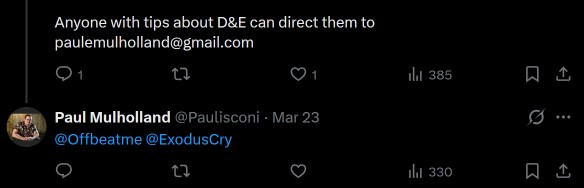
Mulholland openly solicits tips, rumors, allegations, and stories from the public through social media and activist networks. On the surface, that might sound normal. Many journalists receive public tips. But legitimate investigative reporting does not stop at collecting accusations from strangers online. That is where the real work is supposed to begin.

Instead, what emerges from Mulholland’s work often feels less like rigorous journalism and more like activist crowdsourcing. Anonymous submissions, emotionally charged allegations, online gossip, ideological narratives, and hearsay all become part of a pipeline where almost anything can potentially be weaponized if it supports the broader narrative he already wants to push.

Paul Mulholland soliciting tips from the public online.

That creates a serious credibility problem. What safeguards are actually in place to prevent disinformation from entering the process? What stops malicious actors, ideological activists, disgruntled ex-employees, online trolls, competitors, or attention seekers from feeding Mulholland false or wildly distorted information?

Real investigative journalism requires skepticism toward everyone, including your own sources. Professional reporters are trained to corroborate claims independently, seek multiple confirmations, review documentation carefully, contact opposing parties for comment, and separate emotional allegations from provable fact. The entire profession depends on verification because false accusations can destroy reputations and lives.

But when activism becomes emotionally intertwined with reporting, verification standards often begin collapsing under the weight of narrative convenience. Information that supports the desired conclusion gets amplified. Information that complicates or weakens the story quietly disappears. The result is not investigation. It is selective storytelling.

And that is exactly the concern surrounding Mulholland’s approach. His public persona increasingly suggests someone more interested in constructing a moral crusade than conducting neutral inquiry. When you already view the world through a rigid ideological framework, the temptation to cherry-pick dramatic allegations becomes overwhelming.

The problem is compounded by the fact that Mulholland appears to operate largely outside the accountability structures that traditionally constrain journalists. Established newsrooms usually have editors, legal departments, standards policies, fact-checkers, and institutional oversight designed to minimize reckless reporting. Independent activism disguised as journalism has far fewer guardrails.

That means the audience is often expected to simply trust Mulholland’s judgment without ever seeing the underlying verification process. But trust is not automatic. It has to be earned through transparency, consistency, accuracy, and professionalism.

At some point, reasonable people are going to ask a very fair question: if Paul Mulholland is primarily collecting activist tips from anonymous strangers online and selectively building narratives around them, how much actual investigative journalism is really taking place here?

Because there is a major difference between uncovering the truth and simply assembling accusations that fit a pre-existing worldview. Right now, Mulholland increasingly appears far closer to the second category than the first.


Activist or Journalist? The Credibility Problem Surrounding Paul Mulholland

There is a strange pattern that starts emerging when you look closely at Paul Mulholland’s public image. For someone constantly presenting himself as a fearless “investigative journalist,” there is remarkably little evidence online that the wider world even sees him that way.

In fact, one of the only places on the internet that explicitly labels Paul Mulholland as a journalist at all appears to be a Swedish Wikipedia page. That alone should raise eyebrows. Real investigative reporters build reputations through major publications, documented work histories, industry recognition, citations by peers, and professional credibility accumulated over years of consistent reporting. They do not build their identity around self-created mythology and activist echo chambers.

Instead, Mulholland increasingly comes across like a man trying desperately to cast himself as the main character in a story that largely exists inside his own head. Every tweet, every rant, every dramatic declaration feels less like journalism and more like performance art for a niche online audience already emotionally invested in the same ideological battles.

The only place online calling Paul Mulholland a journalist appears to be a Swedish Wikipedia page.

The problem with this self-inflated image is that serious investigative journalism requires discipline, restraint, neutrality, and above all else, credibility. Journalists are expected to gather facts carefully, separate personal feelings from reporting, and avoid becoming emotionally entangled in the narratives they cover. Mulholland repeatedly demonstrates the exact opposite behavior.

His online presence is filled with emotional outbursts, ideological sloganeering, insults directed at people he dislikes, and grandiose activist rhetoric that makes it impossible to separate the man from the agenda. Instead of appearing as a detached investigator following evidence wherever it leads, he presents himself like a political crusader searching for villains to attack.

That distinction matters. Advocacy and journalism are not the same thing. A journalist investigates events even when the truth is inconvenient to their own worldview. An activist begins with a conclusion and works backwards from there. When you examine Mulholland’s public conduct, it becomes increasingly difficult to believe he is capable of separating those two roles.

There is also an unmistakable air of self-importance surrounding the entire persona. Mulholland often frames himself as though he is standing alone against massive hidden forces, exposing corruption with heroic determination. But outside of the small online circles already aligned with him ideologically, the broader public recognition simply is not there. The gap between how he portrays himself and how little institutional credibility actually exists becomes impossible to ignore.

And that is ultimately the core issue. Credibility cannot simply be declared into existence through social media posts, emotionally charged podcasts, or activist rhetoric. It has to be earned through professionalism, consistency, accuracy, and public trust over time.

Right now, Paul Mulholland appears far more invested in maintaining the fantasy of being an embattled crusader than demonstrating the calm, disciplined standards expected of an actual investigative journalist. The louder the theatrics become, the harder it is to take the performance seriously.

At some point, people have to ask an uncomfortable question: if the only place seriously presenting Paul Mulholland as a notable journalist is a Swedish Wikipedia page, is he really an investigative reporter at all, or simply an activist trying to market himself as one?


When Fake Journalism Gets Personal: The Public Meltdowns of Paul Mulholland

Credibility isn’t just built on what you write, it’s built on how you conduct yourself when people are watching. In Paul Mulholland’s case, his public behavior has become a liability that no amount of “investigative reporting” can paper over.

Professional journalists know that maintaining composure in interviews, public appearances, and online spaces is non-negotiable. Yet Mulholland has shown time and again that he can’t keep the line between personal emotion and professional duty clean. One particularly damning example: during a podcast meant to address the adult industry, Mulholland veered wildly off-topic, ranting about his favorite sports team’s loss and making irrelevant political jabs. Worse, he stooped to openly mocking the appearances of adult performers, the very individuals he claimed to advocate for.

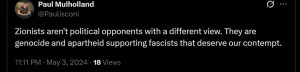
But the problem runs even deeper. Paul Mulholland’s Twitter account reveals a disturbing pattern of extremist rhetoric, particularly concerning Israel and Jewish people. On May 1, 2024, Mulholland tweeted:

“Zionists aren’t political opponents with a different view. They are genocide and apartheid supporting fascists that deserve our contempt.”
https://x.com/Paulisconi/status/1786639869374005

In another tweet:

“Zionists only know violence.”
https://x.com/Paulisconi/status/1785780990880686184

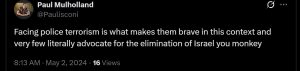
And perhaps most shockingly, when defending protesters who openly chant “From the river to the sea”, a phrase long associated with calls for the destruction of Israel, Mulholland responded:

“Facing police terrorism is what makes them brave in this context and very few literally advocate for the elimination of Israel you monkey.”
https://x.com/Paulisconi/status/1786051373135446427

This is not the language of a journalist. This is the language of an activist consumed by ideology. Mulholland’s use of slurs, blanket smears against an entire people, and dishonest minimizing of eliminationist rhetoric shows he is not interested in reporting the truth, he is interested in picking a side and fighting a propaganda war.

These emotional outbursts and extremist tirades don’t just make him look unprofessional; they completely shatter the fragile trust necessary between a journalist and the public. With the way Paul Mulholland approaches the subjects he examines, you have to wonder if he had originally tried his hand at comedy and flunked out. If you can’t stay focused and respectful when the spotlights on you, how can anyone trust the care and accuracy of your reporting behind closed doors?

Public decorum matters. Self-control matters. And if Paul Mulholland wants to be seen as a serious journalist rather than a fake reporter with a keyboard, he needs to realize that every public meltdown, every insult directed at the looks of actresses in adult films, every antisemitic screed and every dishonest activist talking point chips away at whatever credibility he has left.

Journalism demands steadiness under pressure and respect for the subject you’re covering. Right now, Mulholland is showing the exact opposite, and he’s doubling down on it.